Pass IELTS, JAMB, WAEC, & more with EduPadi CBT App
Practice questions, get instant scores, understand solutions with smart AI insights, and track your progress.
2027 WAEC Hybrid Exam: What SS3 Students Need to Know and Do Now
The short answer:
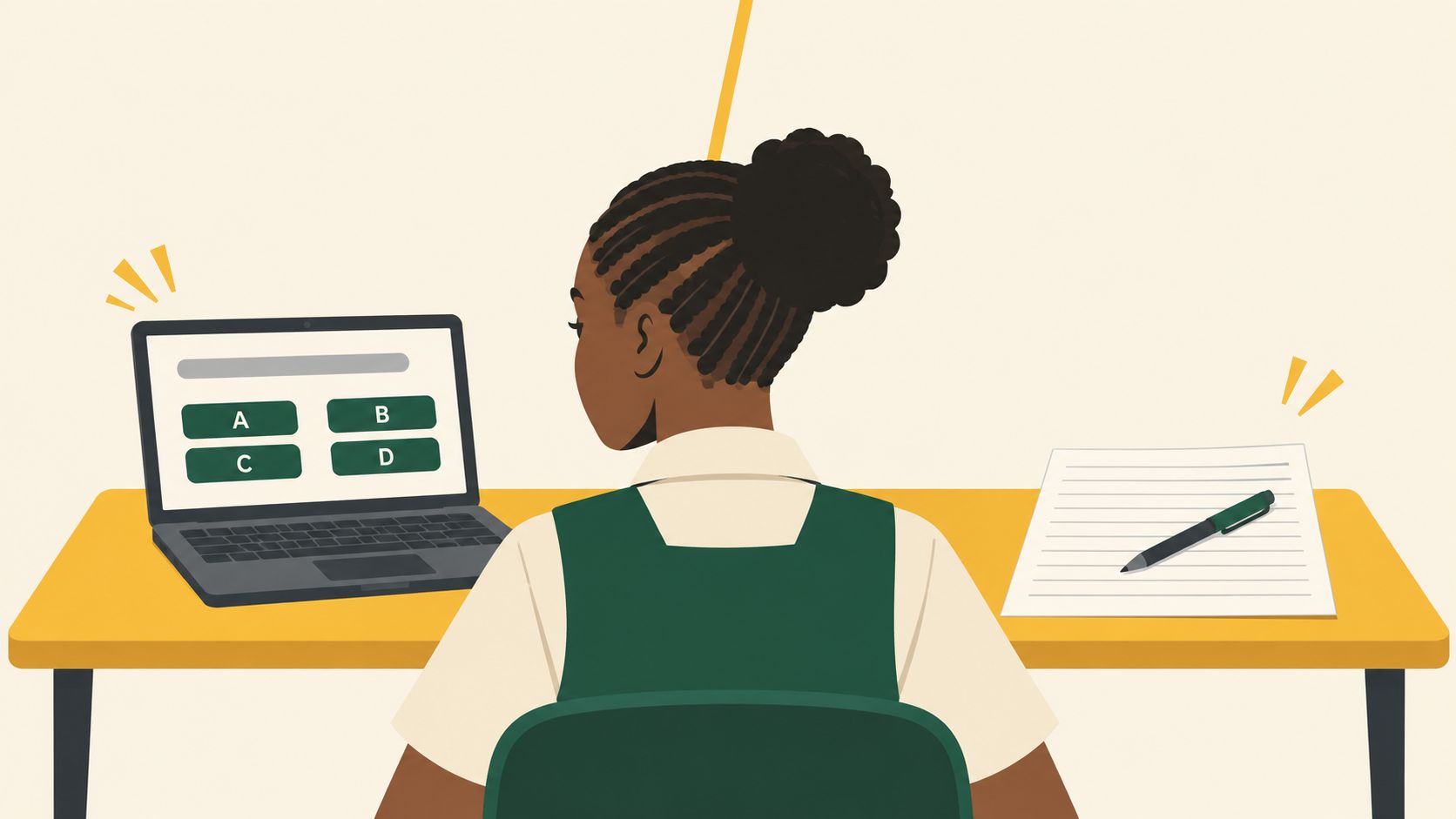
The 2027 WAEC exam for school candidates will be hybrid. WAEC confirmed this on November 17, 2026, when it opened registration for the 2027 WASSCE. Based on WAEC's earlier computer-based exams, you should expect to answer objective (multiple-choice) questions on a computer and write essay and practical papers on paper.
WAEC has not yet published a subject-by-subject breakdown. But you don't need every detail to start preparing. If you are in SS3 now, the computer-based part is the new skill to build, and you have about five months to build it.
Want to start practising today? The best way to get ready for the computer-based part is to answer past questions on a screen, against the clock. You can do that on the EduPadi CBT app, which marks you instantly and explains the solutions. Then read on for what you need to know about the 2027 exam.
This guide covers what is confirmed, what is still unclear, the provisional exam dates, what to sort out with your school, and a month-by-month plan you can start this week.
WASSCE = West African Senior School Certificate Examination. CBT = Computer-Based Test.
What exactly did WAEC announce?
WAEC's announcement was short. It said registration for the 2027 WASSCE for School Candidates is open, that the exam "will be conducted in hybrid mode", and that schools should upload CASS scores promptly and keep to registration timelines (WAEC on X, reported by Legit.ng).
CASS = Continuous Assessment Scores, the marks your school records for you in SS1 to SS3 and sends to WAEC.
Here is what that means in practice, separated into what you can rely on and what you should not assume yet.
| Point | Status | What it means for you |
|---|---|---|
| 2027 WASSCE for school candidates will be hybrid | Confirmed by WAEC | Some papers on computer, some on paper. Prepare for both. |
| Registration is open | Confirmed by WAEC | You register through your school, not on your own. |
| Schools must upload CASS promptly | Confirmed by WAEC | Your SS1–SS3 school marks count. Make sure they're correct. |
| Objective papers on computer, essays and practicals on paper | Reported, based on WAEC's earlier CBT exams | Very likely, but wait for WAEC's subject list to be sure. |
| Registration closing date and fee | Not announced publicly by WAEC | Ask your school's exam officer. Ignore figures you see on social media. |
| Which subjects or papers are on computer | Not announced | Practise objectives on screen for all your subjects. |
Be careful with posts that quote exact fees and deadlines. Some circulate without a link to an official WAEC notice. Check official WAEC sources for the real figures.
What will the hybrid exam look like?
Most likely, each subject will still have its usual papers, but you'll take them in different ways: Paper 1 (Objective) on a computer and Paper 2 (Essay) and any practical on paper. That is the model WAEC has used for private candidates since 2024, and news reports on the 2027 announcement describe the same split.
Isn't WAEC already computer-based?
Partly. For the 2026 WASSCE, school candidates could choose between "computer-based testing and the traditional pen-and-paper format" for the second year running (ThisDay). WAEC also randomised question order so that no two candidates saw questions in the same sequence (Arise News).
What's new for 2027 is that WAEC has named the hybrid format for school candidates from the start of registration. So plan as though your objective papers will be on a screen.
What changes when objectives move to a screen?
The questions test the same syllabus. What changes is how you work:
- No shading. You click an option instead of shading a bubble.
- One question at a time. You may not see the whole paper at once, so skimming and coming back takes practice.
- A clock on screen. Some students work faster with it; others panic. Get used to it before May.
- Rough work on paper, answers on screen. For Maths, Physics and Chemistry, you'll calculate on rough paper and then select on the computer. Moving between the two costs time.
- Your neighbour's order isn't yours. With randomised questions, "question 12" means something different for each candidate.
A quick timing check
WAEC's own timetable for the 2026 private candidates' exam gave General Mathematics 1 (Objective) 1 hour 30 minutes (WAEC timetable PDF). If your objective paper has 50 questions in 90 minutes, that's 1 minute 48 seconds per question. Spend four minutes on one hard question and you've used the time for two others. Timed practice on a computer is the only way to make that pace feel normal.
When is WAEC 2027?
WAEC has not released its 2027 timetable. A provisional, harmonised schedule shared by JAMB in October puts the WASSCE from May 11 to June 18, 2027. JAMB said these dates are "provisional and subject to official confirmation" by each exam body (Nairametrics).
| Exam | Provisional 2027 dates |
|---|---|
| JAMB UTME | March 15–25 |
| NECO SSCE | April 1 – May 14 |
| WAEC WASSCE | May 11 – June 18 |
| NABTEB | June 1 – July 5 |
The big takeaway: if you're writing UTME, NECO and WAEC, all three could fall between mid-March and mid-June. Last year the UTME was in April. An earlier UTME takes about a month off your preparation time, so a study plan that starts in March is starting too late.
The good news: JAMB's UTME is fully computer-based, and WAEC's objective papers are moving to a screen. Time spent on CBT practice for one helps with the other.
What should you sort out with your school now?
School candidates don't register themselves. Your school registers you on WAEC's portal, so your job is to give the school correct details and check them before they're submitted. Mistakes here are far harder to fix after the exam.
Tick these off before the Christmas break:
- Confirm your subjects. WAEC Nigeria allows a minimum of eight and a maximum of nine subjects, including English Language and General Mathematics. Check your list matches what you want for JAMB and your future course.
- Check your name and date of birth. They should match your birth certificate and NIN (National Identification Number) exactly. A spelling difference can cause problems at admission time.
- Have your NIN ready. WAEC added the NIN to registration in 2026 (Arise News) and now lets candidates generate result-checking PINs with it (ThisDay). Ask your exam officer if it's required for 2027.
- Ask about CASS. Ask whether your continuous assessment scores have been uploaded, and that they're correct.
- Ask for the fee and the school's deadline in writing. Pay only through your school's approved channel.
- Ask whether your school will run a CBT mock. If it won't, plan your own (see below).
For parents: the most useful question to ask the school this term is: "Will my child sit at least one full mock on a computer before May?" If the answer is no, it's worth arranging practice at home or at a CBT centre.
How should you prepare for the 2027 WAEC hybrid exam?
Prepare for two exams in one: speed and accuracy on screen for objectives, and clear, well-set-out handwriting for essays and practicals. Here's a plan from now until the exam, built around the provisional dates above.
| When | Focus | What to actually do |
|---|---|---|
| December | Get comfortable on a computer | 20–30 minutes of objective questions on a phone or computer most days. Untimed is fine. Learn to move between questions and change answers. |
| January | Find your weak topics | One timed objective set per subject each week. Keep a list of every topic where you score below half. Revise those first. |
| February | Build exam pace | Full-length timed objective papers. Aim to finish with 5 minutes to spare. Keep writing one essay or theory answer per subject per week by hand. |
| March | Mocks (and UTME if you're writing it) | One full mock per week: objectives on a screen, essays on paper, the same day. Review every wrong answer and note why you missed it. |
| April – early May | Polish and practicals | Past essay questions under time. Practicals with your teachers. Keep up daily short CBT drills so the screen stays familiar. |
Common mistakes in computer-based exams
These come up again and again when students switch from paper to screen:
- Leaving questions unanswered. On paper you see blank bubbles. On screen, a skipped question is easy to forget. Use the question navigator before you submit.
- Submitting early by accident. Know where the submit button is, and don't touch it until you've checked your work.
- Copying a calculation wrongly. You get the right answer on rough paper, then click the wrong option. Read the option twice before you move on.
- Losing time on one question. Pick your best answer, flag it if you can, and come back.
- Only practising on paper. Doing past questions in a notebook builds knowledge, but not screen speed. Do both.
Your next step
This week, do one timed set of WAEC objective questions on a screen in your weakest subject. Note your score and how long it took. That's your starting point, and every week after should beat it.
You can practise WAEC and JAMB past questions in CBT mode on the EduPadi CBT app, which gives you instant scores and explanations of the solutions. For topic-by-topic revision, the EduPadi WAEC Past Questions is here to help.